ˈæn.ɪ.meɪ?
Anime - Why Should You Watch it?
Nobody will even read this I'm sure so I will just ramble on with what whatever comes in mind. This is in no way a proper essay but if you still decide to read it, you have my thanks lol.
I'll start of with this, I hated anime, immensely. Just hearing the word, threw me into a spiral and was repulsed at the mere thought of it. But now I love anime, and I hope I can share this joy to you who is reading this and maybe convince you to join the "dark side".

Before I was "enlightened" at 10th grade. I always thought it was pretty childish, crass at times and don't get me started on how they scream out their moves before they attack, sneak attacks included and I think I'm almost deaf at this point cause of that. But there is a few mildly interesting reasons why they do that, which I hope you'll google it yourself, if I manage to get you mildly interested in anime. As I was saying, it all started at 10th grade when my class had a free period (in fact 2 actually) and we all decided to watch a movie on the class projector, and it just so happens that there was nothing but one anime movie that a fellow mate had on him on a pen-drive. The whole class let out a groan but at least it was better than nothing. I was also contemplating between just straight up sleeping or just watch the damn movie.

I am glad I did watch it in the end. The first few minutes grabbed me with its beautiful artwork. It was like nothing I ever saw in anime usually. (I also didn't know much anime too back then, just Naruto and Dragon Ball Z really. On a side note, I really enjoyed Naruto but it didn't change my views on anime still up till that point). The art style was visceral and vivid, unlike anything I've seen before. The introduction to the story also broke my preconceptions of anime too. It was down to earth, with no superpowers, screaming and overall weirdness, just a simple and honest story. In hindsight it was also probably because of my teenage hormones I was interested in romance novels and movie also happened to be a love story so it probably made me more willing to watch it. After just 30 minutes it engrossed me and later on at the end of the day, I literally begged the boy to borrow his pen-drive so that I could watch it during the weekend. After I finished it, it stuck on my mind, mainly the visual direction and music of the movie, and enjoyed the entire duration of the movie, though I will admit the plot was a bit under-cooked at parts and the characters not fleshed out enough, understandably because of the time restraints, doesn't handle of the complex themes well but is still way better than the average love movies in my opinion. A must watch if you're a fan of romance! And also at-least way better than the movie adaptation of "The Fault In Our Stars". Man that was train-wreck.
Needless to say, after that I was bit more open to explore anime and come to realize that anime is more of a medium rather than a genre. Calling anime childish would be calling film childish. Now if that still hasn't convinced you yet, I'd say just try any ONE of the anime given below, that you see is mildly interesting and see how it goes. And while this list is not an exhaustive one by any means nor does it tries to be one, it should be a decent starting point to look at. Anime isn't for everybody but I hope that you find something that is for you.
Koe No Katachi

Koe No Katachi is my first anime and is the one I've been talking about this whole time. It tells the heartwarming tale of Shouya’s reunion with Shouko and his honest attempts to redeem himself, all while being continually haunted by the shadows of his past.
Elementary school student Shouya Ishida sought to beat boredom in the cruelest ways. When the deaf Shouko Nishimiya transfers into his class, Shouya and the rest of his class thoughtlessly bully her for fun. However, when her mother notifies the school, he is singled out and blamed for everything done to her. With Shouko transferring out of the school, Shouya is left at the mercy of his classmates. He is heartlessly ostracized all throughout elementary and middle school, while teachers turn a blind eye.
Now in his third year of high school, Shouya is still plagued by his wrongdoings as a young boy. Sincerely regretting his past actions, he sets out on a journey of redemption: to meet Shouko once more and make amends.
A place further than the universe

This is a show that I believe is one almost anyone would enjoy, even if you are one who enjoys high octane packed action or stories that have a slow burn which leads up to a mouth-watering ending.
I vividly remember the day I watched it too. I took it up cause it sounded sciencey and all that and was looking forward to some sci-fi. Boy I was wrong and am glad that I was. When I watched I was at a low point in my life and was generally not motivated to do anything at all. While I did enjoy my life it yet felt unfulfilling to me. I was on a 12 hour train ride and to entertain myself I took up this up and it resonated with me in way that no other visual medium has ever done even today. It is a masterclass in writing, sound design and direction. It is about a story about of a four teenagers who are not getting what they want to do in life and come together over a crazy plan to go Antartica. A story about doing what everyone else says is impossible, about supporting your friends and following your dreams with them. And if me gushing over it has YET STILL not convinced you to pick this up immediately, I will spoil a bit to hopefully get your attention.
At its heart "A place further than the universe" is a about friendship and unlike other shows where they shove it in your face that having friends is important, over and over, this anime shows the real value of friendship and instead make your ruminate on friendship and those in particular those parts that are hard to be expressed in words. Each of the four girls in the story has something missing in them. Mari feels the need to do something with her youth (a feeling that i can immensely relate to). Shiraze wants to go to Antarctica to cope with the death of her mom and learn to open herself back to others. Hinata wants to do something big different than the one she left behind in school but needs to learn how to rely on other people. Yuzuki wants to make friends and needs to learn what friendship means in the first place since her life as a child actress has her cut off from her peers.
And while there is something that you can resonate in each of their stories individually, what is really amazing is how these stories all enhance each other. Mari's drive to make something of herself, serves as the catalyst of the story. Shiraze big and impossible goal, provides everyone a tangible goal to work towards, which works as a stand-in that for the abstract goals that are their reach goals. Hinata is there to support the others and encouraging them with a smile where Mari's job is to cry for the team. Yuzuki is the glue that holds all them together with her simple desire for friendship. The emotional climaxes of episode 1 and 2 made my heart soar. I was a bit sad on Mari's misspent youth shown at the start of the series but what really got me to cry hard was Yuzuki's reaction to the other girls showing up in her hotel room. And once everyone is in place once the water works starts flowing, trust me they do not stop.
Man I can't stop crying after just rewatching some parts to get a thumbnail for this. I don't think I can't write more, it is a must watch. Also after watching this I'm sure you'll want this. Thank me later.
I Want To Eat Your Pancreas

While as the title may suggest, I assure you that this is not at all about cannibalism but is instead about is one of the most heartbreaking anime films I've watched. The story revolves around an unnamed quiet and solitary young man who works in the library and seems completely unperturbed by his standing as a loner. But a chance encounter with the most popular girl in his class shakes up quite some things. He discovers that the girl, Sakura, is dying of a pancreatic disease and only has a few years left, at most. She's kept it a secret from her friends so she can still enjoy a normal teenage life before she dies, but the young man proves to be the perfect outlet for her fears about the illness. He becomes her secret keeper and reluctant companion as she tries to finish everything on her bucket list before her time runs out.
While the film flirts with more obvious arcs, it subverts them in interesting ways. Sakura and the boy don't necessarily fall in love, but that potential (and the fact that everyone at school assumes they're dating) is definitely played with in interesting ways. The unnamed boy's personal arc explores his chosen isolation and even hints at his crippling depression, making his growth through his experiences with Sakura about more than just friendship. The film is heady and willing to explore the complicated feelings of being a teenager, even without the lingering expectation of death hanging overhead. As a bittersweet and meaningful story, the film succeeds with gusto.
Also interestingly, unrelated to the plot of the movie, at the screening for the film, representatives from Aniplex made sure to hand all members of the audience a box of tissues. It just goes to show how much confidence the studio had in the film being able to evoke the appropriate emotions, and it proved to be a good call. There wasn't a dry eye in the theater after the movie concluded.
Ghost In The Shell
It is widely considered as one of the best science-fiction films of all time which went on to inspire the Matrix Trilogy. What’s more, the story of an artificial intelligence that evolves to such an extent that it demands to be treated as a new life form is more relevant today than when the film was made. Although it is pinned to an action-oriented story-line, Ghost in the Shell features many philosophical scenes that explore the way humans relate to computers – and vice versa – and it even veers into metaphysics to discuss the nature of existence itself.
The story is set in a fictional Japanese city in 2029. In a time when most humans are cybernetic-ally enhanced to live longer and perform better, Major Motoko Kusanagi is simply the most extreme example of how the lines between what’s human and what’s technological have blurred. She works for a criminal investigation unit called Section 9. Even though Motoko’s body is a machine she still bears the traces of her human mind, or even a soul – the “ghost in the machine” of the title. When Motoko and her team are called in to investigate a rogue AI program – the Puppet Master – that has the capability to “hack” human minds and implant artificial memories, they assume it’s the creation of the government department that is trying to capture it. But further investigations show that the program may have developed at such a speed that it was ultimately able to create itself. The Puppet Master claims that in the course of acquiring masses of information from the internet, it has transcended the limitations of a machine and has become a living entity. What’s more, it seems to have plans for Motoko.
The story examines many issues that have come to the forefront of scientific debate, including the ethics of AI, what happens when AI becomes more intelligent than its human creators, the possibility of machines evolving once they have absorbed enough information and the notion that life forms may spring from information systems that are not organic in nature. The director’s own view is that technological advances may not always benefit humanity, but they will happen regardless, so humanity must learn to live alongside the technology it creates, and technologies that create themselves.
Odd Taxi
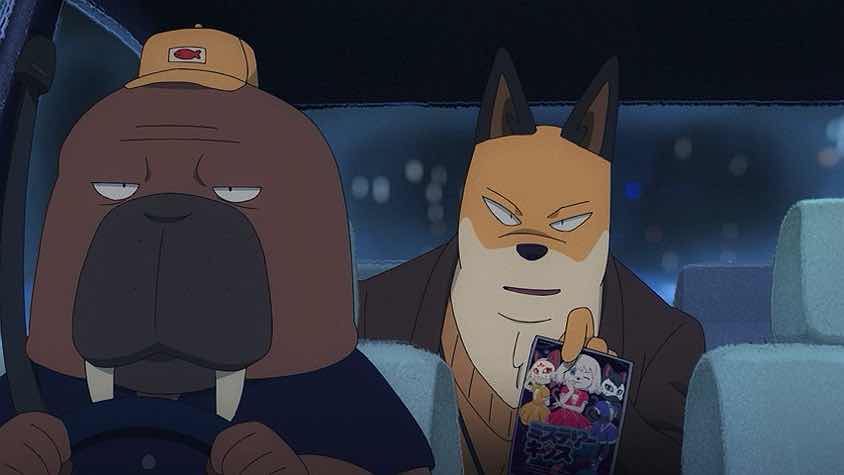
Odd Taxi is a crime thriller and as an average thriller enjoy-er, who has read countless thrillers and watched lots of them to the point where I could predict the outcomes fairly accurately, I can safely assure you that this show is comparable up to the greats. It's strength is how it weaves a bunch of seemingly random people’s lives together into the large tapestry that is the overarching plot, with a 41-year-old taxi driver caught up in the middle of it all. Starting with that taxi driver (named Odokawa), the show does something that is quite rare when it comes to the protagonist: they hide aspects of them from the audience. It is usually common sense to have your viewer know everything there is to know about your main character early on. Maybe there’s a tragic backstory revealed in the second act to garner some extra sympathy, but the writer will often try their best to endear you to the protagonist as quickly as possible.
Not to say that Odokawa isn’t endearing or relatable, as he is usually the straight man (or straight walrus in this case) around a cast of more vibrant and wacky characters, but the show also paints him as someone whose got something to hide. It’s a tricky balance to pull off as you can imagine, making a character that is both loveable but also slightly suspicious, yet, Odd Taxi pulls it off effortlessly. But this is more than just a story of one person, and the supporting cast manage to have their own compelling struggles, mysteries and goals for the viewer to get invested in, with pretty much everyone getting their personal time in the spotlight. But intrigue is what Odd Taxi excels at, and despite its adorably quaint art style, there are some scenes that get pretty dark towards the end, adding that spice of danger to events. With a brisk 13-episode runtime, it manages to tie the majority of its loose ends into a satisfying finale, and while the potential for another season is certainly there, I would be genuinely okay if we didn’t get any more Odd Taxi after this.
And if the animorphic aspect turns you off as it did a bit to me also at the start, rest assured that there is actually a very good reason plot wise on why that was one. And the hints to that question is already given in the opening which you will never understand until you finish the anime. I mean if that doesn't excite you, what else will?
Serial Experiments Lain
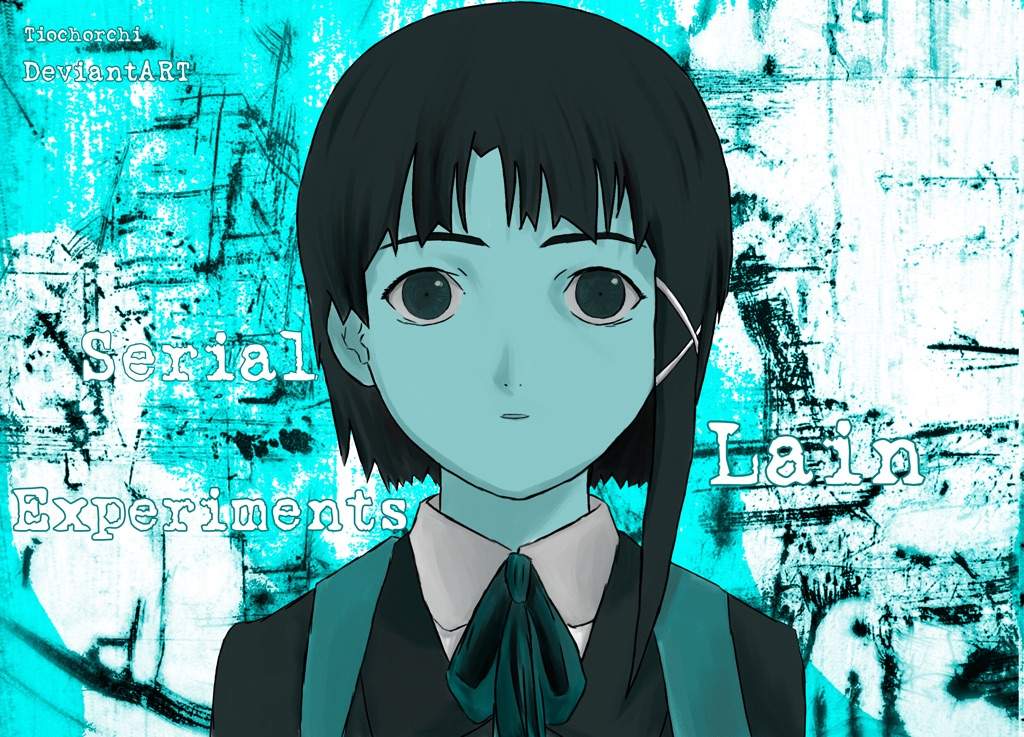 If you love dissecting media, piece by piece this is one is for you! And if you also love horror, this is also for you too! But I will start with a disclaimer that it is a tad bit confusing and I haven't grasped it much, not much of a surprise as I'm not really smart lol. But what I can promise you though is that this is one media that you've never seen before and is very unlikely that there will be one like it ever again.
When we start watching Serial Experiments Lain, we quickly realize that the internet we're on at the very moment was only one potential to come of many. The internet could have been any sort of multitude of various things, but here we are with monopolies selling our data, advertisements ready to pop up around every corner, sometimes popping up over each other. The general story is about the internet and the real world colliding and our main character lain is in the center of this madness and goes through and identity crisis throughout the story where who is she really? The Internet Her or the Real Life Her?
Serial Experiments Lain is more of a puzzle and needs a bit of a participatory storytelling. You might need to dig into real-life history and conspiracy theories that it references to understand it better. Otherwise it might come across as feeling short and confusing with an ambiguous conclusion. But it is not really needed and you will be to enjoy for what it is and will surely make you think about our relations with technology.
Banana Fish

Banana Fish series is an anime that is based on the manga of the same name that has uncountable praises to boast about. In retrospect, the manga was light years ahead of its time and has only recently resurfaced with an anime adaptation more than three decades later. It covers a broad range of themes such as Adventure, Crime, Thriller, Romance, Bl, LGBTQ amongst many others. But it is also revolutionary in the sense that the manga came out at a time when such themes were not popular at the time. It has a tragic story and is not for one looking into for a lighthearted one.
The story of one of the central protagonists of the series, Ash Lynx, begins as he becomes another one of the many young teens of New York on the run from their problematic families. What makes his story different from those many teens is that he just happens to be rescued from the notorious streets of New York City by none other than the most powerful crime lord of the city, Dino Golzine. As fate would have it, Dino Golzine is not just a leader of a small gang but the Godfather of the mafia.
Life is not easy on Ash, but stronger the challenges he faces, he finds the strength to persevere. Years pass, and Ash, now at the pivotal age of 17, finds himself to be a well-respected leader of his own gang. Life seems to be going well, but that is just a deception to the eyes of many on the surface. What the onlookers don’t know is that Ash works day in and day out to make use of the resources that he has at hand to look into the mystery of ‘Banana Fish’.
They are the two words that carry the weight of the world on Ash’s shoulders and are the very source of his neverending nightmares. ‘Banana Fish,’ although simple words that may sound initially innocent to the unaware, are but the very same words that he frequently finds his traumatized older brother, Griffin, muttering since his return from the Iraq War. Ash’s investigations are, however, put to a stop when Dino himself sends his men after Ash in an attempt to overthrow the investigation.
At the hideout, Ash’s friend Skip introduces him to Japanese photographer Shunichi Ibe and his assistant, Eiji Okumura, who want to uncover the secrets of the American street gangs. Worst comes to worst when Ash is tipped off about the wrathful intervention of Dino. Soon after, Dino’s men raid the pub, kidnapping Skip and Eiji, ensuing a string of mayhem and chaos. Now, it all boils down to Ash and his abilities to not only save his friends and put a stop to the actions of Dino but also to somehow continue his investigation on the infamous Banana Fish.
Mushishi
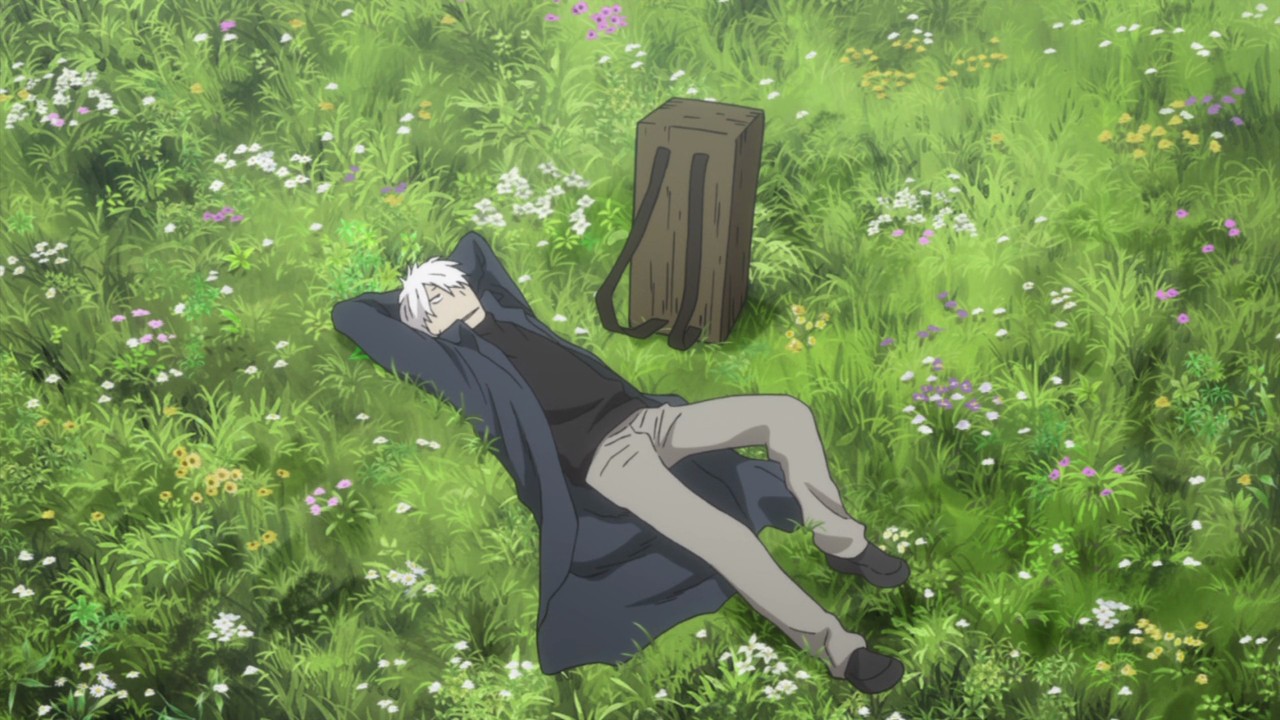
This is an interesting one. But Mushishi isn't really for everyone, if slow-paced shows with heavy dialogue isn't your thing, then this is a show that just isn't for you, and it most certainly isn't binge worthy, as its a series that you have to take your time with and be "in the mood" to watch for when you feel like it. This show is very episodic and binging it actually lessens the experience because each episode is appreciated more when it's fully absorbed afterwards. I didn't know at first and first tried binging it and gave up. But then I just picked it up from time to time and soon started watching it every night before bed and started enjoying this show immensely. Also an analogy I'd give to fellow gamers is that to me it feels like The Witcher 3 but in anime sort of.
The overall premise to Mushishi centers around the phenomena of mushi, mysterious creatures invisible to the human eye who are described to be life "at its purest form", and are capable of taking any form necessary if it means the benefit of their number one purpose in life: survival. However, due to their supernatural nature, many of their methods can clash and meddle with the lives of other human beings, said “methods” even bringing harm upon them. This is where our main character named Ginko comes in, a mysterious man who takes the role of a Mushi master (or a "Mushishi" as the title refers to), and spends most of his life on his travels helping those whose lives have been afflicted by the mushi, while also striving to gain more knowledge on them in order to find a way for both mushi and humankind to coexist in harmony.
Mushishi covers several topics that range from existentialism, consciousness, symbiosis, etc, but what can be argued as one of its most meaningful themes is its portrayal of morality, and its presentation of human existence. While many of the conflicts are stirred by the mushi, at the end of the day, the mushi aren't entirely to blame, after all, the only thing they actively want is to just live, and we humans seek that too, its just that our different lifestyles as previously stated differ far too much for us to live together. This right here is one of the core aspects of Mushishi, none of the characters are portrayed as good or bad guys, just people trying to live their lives as best as they can, and this applies to the mushi as well. But life comes in and says that things can't always go their way, and the difficulties that come with their lives and coexistence are essentially unavoidable. This otherwise sends out a rather somber but significant message about life, suffering is inevitable, its cause is not to be blamed towards something, but simply a part of life that must be accepted to go on living with yourself. Many of the characters face some form of suffering not directly because of the mushi, but because nature couldn't have both species be compatible with each other, which leads to all the trouble that occurs, some accept it, others reject it, but no matter what they decide, the outcome can never be foreseen. This gray viewpoint morality and life would allow for Mushishi to explore several facets of life and human nature, and would act as an incredibly compelling component for the series, as how it explores is both intriguing, and superbly executed.
Grave of the Fireflies
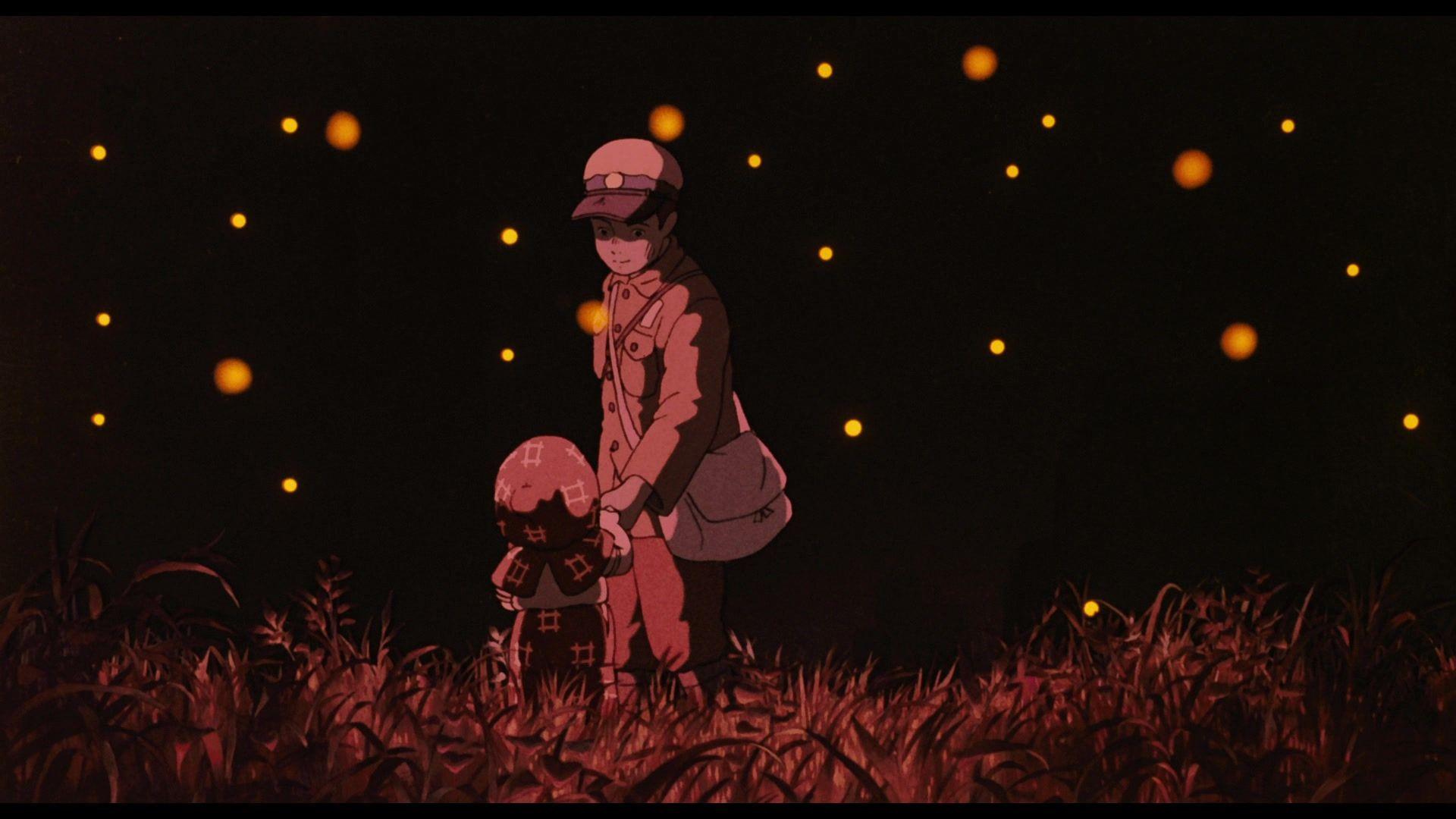
This is one movie that I would like to never re-watch again because of how heart breaking it is. Saying this movie broke my heart is an understatement. I will keep this short as the mmore I think about it I get depressed.
I have never seen any movie depict war the way Grave of the Fireflies does. In almost every war film or anti-war film I’ve watched, the focus is on the soldiers fighting in the war and how it affects them not only physically but psychologically.
This film has no soldiers or fighting. The closest thing we get to that in this movie are the firebombings conducted by the Allied forces, but that was no battle, that was senseless mass murder of innocent people. That’s where this film’s focus is at, the civilians whose country is being attacked. Takahata (The director) pulls no punches when showing how horrifying it was for these people who were literally having bombs dropped on their heads from the sky. If that was not bad enough, these people aren’t getting the help they desperately need. There are sirens for when a firebombing is about to occur and they have shelters to go to, but for the most part, these people are on their own. This movie’s message is very clear: War is ugly and there is nothing pretty about it. It’s impossible to imagine what it was like to be in those people’s shoes.
Kids On the Slope
 Introverted classical pianist and top student Kaoru Nishimi has just arrived in Kyushu for his first year of high school. Having constantly moved from place to place since his childhood, he abandons all hope of fitting in, preparing himself for another lonely, meaningless year. That is, until he encounters the notorious delinquent Sentarou Kawabuchi.
Sentarou's immeasurable love for jazz music inspires Kaoru to learn more about the genre, and as a result, he slowly starts to break out of his shell, making his very first friend. Kaoru begins playing the piano at after-school jazz sessions, located in the basement of fellow student Ritsuko Mukae's family-owned record shop. As he discovers the immense joy of using his musical talents to bring enjoyment to himself and others, Kaoru's summer might just crescendo into one that he will remember forever.
Kid's On the Slope is a heartwarming story of friendship, music, and love that follows three unique individuals brought together by their mutual appreciation for jazz. But even if you're not interested in jazz like me, I still highly recommend it as the story is well grounded in reality and is overall a very enjoyable drama.


Comments
Post a Comment